Inside Edmonton

Pabian Realty Presents

Sign up below for new weekly content on the market, the charm, and the people that make Edmonton like no other city in Canada

What’s happening in the market today?

RSS

Kiniski Gardens, Edmonton: A Deep Dive Into a Hidden Gem in Mill Woods

If you are looking for a community in Edmonton that strikes the perfect balance between nature, family-friendly amenities, and real estate affordability, Kiniski Gardens should be right at the top of your list.

Tucked away in the vibrant Mill Woods sector of Southeast Edmonton, Kiniski Gardens is one of the 26 distinct neighbourhoods that comprise the greater Mill Woods area. With tree-lined streets, exceptional access to the Mill Creek Ravine, and a well-established residential feel, it represents everything home buyers love about mature Edmonton neighbourhoods without the steep price tag found in other areas of the city.

The History and Name: Julia Kiniski, "Big Julie," and the Market Gardens

Kiniski Gardens carries a proud piece of local Edmonton political history. The neighbourhood is named in honour of Julia Kiniski (1899–1969), a Polish-born local reform politician who made a lasting mark on Edmonton City Council.

  • The Story of Julia Kiniski: Before her eventual victory in 1963, Julia Kiniski ran for city alderman ten times. Her tenacity earned her the affectionate nickname "Big Julie" and reinvigorated public interest in local municipal council meetings. She was only the third woman ever elected to Edmonton City Council, going on to be re-elected three times and leading all council candidates in votes during the 1968 election. She was also the mother of six children, one of whom became professional wrestler Gene Kiniski.

  • Historical Agricultural Roots: Long before residential construction took off, the southern portion of Kiniski Gardens formed part of the Edmonton Market Gardens in the late 1910s.

  • The Mill Woods Assembly: The land bank for Mill Woods was assembled by the Government of Alberta starting in 1970, taking its name from Mill Creek and the native Parkland forest trees. By 1971, the City of Edmonton established a formal plan to purchase, subdivide, and sell residential and commercial building lots.

While early development in Kiniski Gardens began in the 1970s (accounting for about 7% of homes), the primary building boom occurred throughout the 1980s (roughly 41%) and 1990s. Kiniski Gardens combines with its neighbour directly to the northwest, Jackson Heights, to form the Burnewood Neighbourhood Area Structure Plan.
Boundaries and Location Context

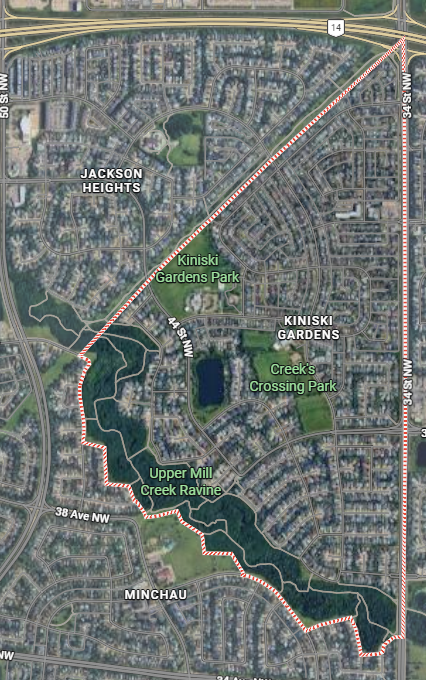
Kiniski Gardens features a distinctive, roughly triangular shape spanning between 1.37 and 1.96 square kilometers. Its clearly defined boundaries give the neighbourhood an insulated, peaceful atmosphere:

  • Northwest: A pipeline utility corridor running between 34th Street near Whitemud Drive down to the Mill Creek Ravine.

  • East: 34th Street.

  • Southwest: The scenic Mill Creek Ravine, which winds southeast and crosses 34th Street.

Features, Parks, and Lifestyle Amenities

What makes Kiniski Gardens such a great place to call home? Simply put: natural beauty and everyday convenience.

  • Mill Creek Ravine Access: Bordering the neighbourhood along the southwest, the ravine offers residents immediate access to extensive walking trails, biking paths, and natural green spaces.

  • Kulawy Lake: Situated right within the neighbourhood, Kulawy Lake is a small, man-made lake surrounded by manicured walking paths and peaceful green spaces that enhance the local landscape.

  • School & Recreational Sites: The focus of the community centers around multipurpose school and park sites. Local educational options include Julia Kiniski Elementary School (Edmonton Public) and Saint Kateri Catholic Elementary School.

  • Community Leagues: Local recreation and social events are supported by the Burnewood Community League and Woodvale Community League, offering community halls, sports programs, and outdoor skating rinks.

  • Commercial Convenience: Residents are served by businesses on local commercial sites along 34th Street and 50th Street, while major retail destinations like Mill Woods Town Centre and RioCan Meadows are just minutes away.

Core Demographics: Who Lives Here?

With a population of approximately 5,600 to 6,600 residents living across roughly 2,000 to 2,200 dwellings, Kiniski Gardens is a calm, mature, and family-centric community.

  • Structure Types: Single-detached homes represent the dominant residential structure, making up between 70% and 95% of total housing units. The remaining properties consist of semi-detached duplexes, row houses, and low-rise apartment condominiums.

  • High Homeownership: Approximately 85% to 89% of homes in Kiniski Gardens are owner-occupied, pointing to strong neighbourhood stability and pride of ownership.

  • Family Profile: The community heavily attracts young families, long-time owners, and buyers looking for traditional 1980s and 1990s layouts—often featuring wood-burning fireplaces, pie-shaped cul-de-sac lots, attached or double detached garages, and fully finished basements.

2026 Real Estate Market Context: Kiniski Gardens vs. Edmonton Average

If you are evaluating home options in 2026, Kiniski Gardens stands out as a compelling value opportunity.

Across the Greater Edmonton Area in mid-2026, real estate activity remains solid with increased listing inventory giving buyers plenty of selection. The average price for a single-family detached home in Edmonton sits at $592,989, with overall residential sales across all categories averaging around $483,600.

By contrast, Kiniski Gardens offers a noticeable pocket of affordability. Single-family detached homes in Kiniski Gardens frequently list and sell in the $320,000 to $460,000 range depending on lot size, garage configuration, and overall finish level. Average list prices in the surrounding zone sit around $462,400.

For first-time buyers and growing families, this represents a 20% to 30% savings compared to the citywide average for a single-detached home. You get the benefits of a detached property, private yard, and garage without stretching your pre-approval to the limit.
Why Kiniski Gardens Makes a Great Place to Purchase Property

  1. Equity Building Opportunity: Buying in at an accessible price point allows homeowners to build renovation equity over time through modern cosmetic updates.

  2. Quiet, Low-Traffic Streets: Thanks to its triangular layout bounded by natural features and utility corridors, Kiniski Gardens experiences minimal cut-through vehicle traffic.

  3. Unbeatable Nature Integration: Having both Kulawy Lake and the Mill Creek Ravine in your immediate neighbourhood provides immediate access to scenic walking and cycling paths.

  4. Convenient Transportation Links: Quick connections via 34th Street, 50th Street, Whitemud Drive, and the Anthony Henday Ring Road make commuting to downtown or surrounding industrial parks simple.

Frequently Asked Questions (FAQ)

Q: Where does Kiniski Gardens get its name?

A: The neighbourhood is named after Julia Kiniski, a dedicated local reform politician who was elected to Edmonton City Council in 1963 as only the third woman to ever hold a council seat. Known as "Big Julie," her civic engagement reinvigorated public interest in local government.

Q: What types of homes are in Kiniski Gardens?

A: The vast majority of properties are single-family detached homes built in the 1980s and 1990s. The area also offers a select mix of duplexes, townhomes, and low-rise apartment condos.

Q: What natural parks and amenities are located in Kiniski Gardens?

A: Residents enjoy direct access to the Mill Creek Ravine along the southwest border and Kulawy Lake, a man-made lake featuring paved walking paths and green spaces.

Q: How do single-detached home prices in Kiniski Gardens compare to the Edmonton average?

A: In mid-2026, the citywide average price for a detached home in Edmonton is $592,989. In Kiniski Gardens, detached homes generally range between $320,000 and $460,000, offering buyers a substantial price advantage.

Q: Are there schools within the neighbourhood boundaries?

A: Yes, Kiniski Gardens is home to Julia Kiniski Elementary School (Edmonton Public) and Saint Kateri Catholic Elementary School.

Ready to Explore Kiniski Gardens Real Estate?

Whether you are looking to buy your first single-family home, relocate closer to nature, or invest in a stable Edmonton neighbourhood, Kiniski Gardens offers an incredible combination of lifestyle and real estate value.

Get in touch today to discuss current listings, market dynamics, and how to find the right property for your goals!

Mike Pabian | RE/MAX Excellence | 5607 199 St NW #201, Edmonton, AB

Read

The Empty House Blueprint: Safely and Successfully Selling a Vacant Property in Edmonton

You’ve moved into your dream home, wrapped up a major renovation, or perhaps you’re managing an estate property. Whatever the reason, you find yourself with a completely vacant house ready to hit the real estate market.

At first glance, selling an empty home feels like a breeze. You don't have to scramble to vacuum before a last-minute showing, there are no pets to wrangle, and the property is always "show-ready." But over the years helping Edmontonians navigate the local market, I’ve learned that vacant homes come with a unique set of challenges.

When we work together at Pabian Realty, my goal isn't just to throw a lockbox on your door and hope for the best. It’s about protecting your equity, minimizing your liability, and maximizing your return.

If you are getting ready to list an empty home in the Edmonton area, here is everything you need to know to ensure a smooth, stress-free, and profitable sale.

1. The Insurance Trap: Don't Let Your Coverage Expire

Many homeowners assume their standard home insurance policy covers the property until the day ownership officially transfers to the buyer. Unfortunately, this is one of the most dangerous—and costly—misconceptions in real estate.

In Alberta, most standard home insurance policies include a strict "Vacancy Clause." If a home is left vacant for more than 30 consecutive days, your standard coverage can become completely null and void.

To keep your investment protected, you must take two critical steps:

  • Obtain a Vacant Property Permit: You need to contact your insurance broker immediately to secure a vacant home rider. This will adjust your premium but ensure you are actually covered if disaster strikes.

  • Establish a Regular Check-in Schedule: Insurance companies typically mandate that a competent person physically inspect the home every 24 to 72 hours. You should keep a written or digital logbook of these visits. If a pipe bursts and you can’t prove the home was checked within the required window, your claim could be denied.

2. Edmonton’s Climate: The Golden Rule of Utilities

When a house is sitting empty, it is incredibly tempting to shut off the utilities to save a few dollars on monthly bills. In Edmonton's volatile climate, doing this is a recipe for disaster.

Our winter temperatures routinely plummet well below freezing. If your furnace isn't running, the water sitting inside your plumbing will freeze, expand, and shatter your pipes. When the weather warms up—or during a temporary winter chinook—those pipes thaw, resulting in catastrophic flooding that can completely ruin your home's structural integrity.

Pro Tip: Keep your utilities fully active. Set your thermostat to a minimum of 15°C to 18°C. This keeps the ambient air warm enough to prevent freezing while keeping your utility costs manageable.

Additionally, keeping the electricity active ensures that your sump pump continues to run during spring thaws and heavy summer rains, protecting your basement from groundwater flooding. From a marketing perspective, a warm, bright, well-lit home is significantly more welcoming to potential buyers than a dark, freezing box.

3. The "Hold Harmless" Clause Decoded

When we prepare your listing paperwork, I may ask you to sign a document containing a Hold Harmless Clause. If you’ve never encountered this term, it can sound intimidating—but it’s actually a very standard industry practice designed to clarify risk allocation.

When a property is vacant, it becomes a hub of unsupervised activity. Dozens of buyers, out-of-town realtors, home inspectors, and appraisers will be accessing your home via a secure electronic lockbox. Because neither you nor I will be physically present for every single showing, a hold harmless clause legally states that you will not hold the real estate brokerage liable for unforeseen events out of their direct control.

Why a Brokerage Requests a Hold Harmless Clause:

  • Showings & Access: If a visiting agent accidentally forgets to turn off a light or turn down the thermostat after a showing, the clause protects the brokerage from being sued over a minor utility spike.

  • Digital Exposure Risks: To sell your home quickly, we market it aggressively across the internet, MLS®, and social media platforms. A hold harmless clause notes that while we are showcasing the property to generate buyers, the brokerage isn't responsible if a third party uses that public data maliciously.

4. Skip the Yard Sign: Mitigating the Risk of Break-Ins

For generations, putting a "For Sale" sign on the front lawn was the universal first step to selling a house. However, when a home is completely vacant, that sign can act as a giant neon billboard for bad actors. It tells vandals, thieves, and squatters: "Nobody lives here, and there is no one inside to catch you."

In today's real estate environment, over 95% of buyers find their next home online through targeted digital marketing, real estate portals, and direct MLS® alerts.

By strategically choosing not to put a physical sign on the lawn, we protect the privacy of the property. Serious buyers will still easily find the listing online and book private viewings, but we drastically reduce the chances of the home being targeted for break-ins or vandalism.

5. Pro Tips for Securing Your Vacant Home

If you want to keep your vacant property safe, the trick is to make it look like someone still lives there. Here is a checklist of the best ways to secure your property during the listing period:

  • Smart Timers: Install smart light bulbs or plug-in timers that turn interior lights on and off at natural intervals during the evening.

  • Wi-Fi Security Cameras: Place a video doorbell (like a Ring or Nest) at the front door and a couple of internal cameras facing the main entry points. This allows you to monitor exactly who is coming and going in real-time.

  • Maintain Exterior Curb Appeal: An unshoveled sidewalk in January or overgrown grass in July is a dead giveaway of an empty house. Hire a local service to handle snow removal and lawn care promptly. Not only does this keep the property secure, but it also avoids costly city bylaws fines.

  • Secure All Openings: Double-check that all basement window wells are secure, sliding patio doors have security bars installed in the tracks, and all deadbolts are fully functional.

6. The Magic of Staging: Turning "Cold" into "Sold!"

Walking through a completely empty house can feel clinical, uninspiring, and cold. Believe it or not, completely vacant rooms actually look smaller to the human eye because buyers lose all sense of scale and spatial context. They struggle to visualize where a couch would fit, how large of a dining table they can buy, or how to utilize an awkwardly shaped bonus room.

Furthermore, when a room is completely empty, there is nothing for the eye to look at except the architecture itself. This means buyers will hyper-focus on every tiny, insignificant flaw—like a slight scuff on the baseboard or a minor blemish on the drywall.

Vacant HomeProfessionally Staged Home
Feels cold, clinical, and uninviting.Feels warm, welcoming, and aspirational.
Rooms appear smaller; lacks spatial scale.Definitively demonstrates furniture layout and flow.
Buyers hyper-focus on minor cosmetic flaws.Buyers focus on the lifestyle and emotional appeal.
Historically sits on the market longer.Statistically sells faster and commands higher offers.

By utilizing professional home staging—even just partial staging of high-traffic areas like the living room, kitchen, and primary bedroom—we breathe life into the property. Staging helps buyers establish an immediate emotional connection, leading to a faster sale and a significantly better purchase price.

Frequently Asked Questions (FAQ)

How often do I legally need to check my vacant home for insurance in Alberta?

While the exact timeframe varies depending on your specific insurance provider, most companies require a physical check-in by a competent person every 24 to 72 hours. Always read the fine print of your vacant home permit and maintain a digital log of every visit.

What temperature should I leave my furnace at during a winter sale?

You should set your thermostat to a minimum of 15°C to 18°C. Never turn the heating system completely off. Keeping it at this level protects your plumbing from freezing while ensuring the home feels warm and comfortable when buyers walk through the door.

Should I leave the Wi-Fi connected in an empty house?

Yes, absolutely. Keeping your internet active allows you to use smart security cameras, remote thermostats, smart lighting timers, and electronic smart locks. It is a minor monthly expense that provides immense security advantages and peace of mind.

Is professional staging really worth the investment?

Without a doubt. Data across the Canadian real estate market consistently shows that staged properties sell significantly faster and for more money than their vacant counterparts. Staging helps buyers see the true potential of a space rather than focusing on empty space and minor cosmetic flaws.

Are you ready to list a property in the Edmonton area and want a seamless, highly strategic experience? Let’s connect. At Pabian Realty, I’m committed to guiding you through every step of the transaction with absolute transparency, deep local market expertise, and personalized attention. Give me a call today at 780-232-2064, and let's get your property sold the right way!

Read

The Ultimate Guide to Buying Foreclosed Properties in Alberta

Whether you are an investor looking for your next flip or an average homebuyer hoping to score a deal on a property, buying a foreclosure in Alberta can be an enticing prospect. However, purchasing a distressed property is vastly different from a traditional real estate transaction.

I believe that an educated buyer is a successful buyer. In this comprehensive guide, we are pulling back the curtain on everything you need to know about buying foreclosed properties in Alberta—from understanding the legal jargon to navigating the court offer process.

What is a Foreclosure?

At its core, a foreclosure is a legal process initiated by a lender (usually a bank) to recover the balance of a mortgage when the homeowner has stopped making payments. The lender forces the sale of the asset used as the collateral for the loan—the home itself.

Why Do Properties Go Into Foreclosure?

Foreclosures are rarely the result of malicious intent; they are usually the byproduct of unfortunate life circumstances. Common reasons a property falls into foreclosure include:

  • Sudden Job Loss: An unexpected loss of income makes it impossible to maintain monthly mortgage payments.

  • Divorce or Separation: The financial strain of splitting assets and maintaining two households can cause mortgage payments to fall behind.

  • Medical Emergencies: Severe illness or injury can lead to both a loss of income and staggering medical bills.

  • Rising Interest Rates: Homeowners on variable-rate mortgages may find themselves unable to afford drastically increased monthly payments.

  • Over-leveraging: Borrowing against the home’s equity too aggressively, leaving no safety net.

Judicial Sale vs. Bank-Owned Properties: What’s the Difference?

In Alberta, when a property goes into foreclosure, it typically falls into one of two categories. Understanding the difference is crucial for your purchasing strategy.

1. Judicial Sale (Court-Ordered Sale)

Alberta is a "judicial foreclosure" province. This means the foreclosure process goes through the Court of King's Bench. In a judicial sale, the property is still technically owned by the borrower, but the court has ordered it to be sold to satisfy the debt.

  • The Catch: Any offer you make must be approved by a judge. The court has a fiduciary duty to get fair market value for the property to protect both the lender and the borrower's remaining equity.

2. Bank-Owned Properties (Foreclosure/REO)

If the property does not sell during the judicial sale process, the court may grant an "Order for Foreclosure," transferring the title directly to the lender. These are known as Real Estate Owned (REO) or bank-owned properties.

  • The Catch: The bank is now the legal owner. You negotiate directly with the bank’s representatives (usually through their Realtor). While you don't have to go to court, the bank will attach extensive schedules to the purchase contract to protect themselves from any liability.

The Risks of "As Is, Where Is"

Whether you buy a judicial sale or a bank-owned property, it will be sold "As Is, Where Is." This is the most critical risk to understand.

When you sign an "As Is, Where Is" contract, the seller makes absolutely zero representations or warranties about the property.

  • No Guarantees on Condition: The furnace might be broken, the foundation might be cracked, or there could be hidden water damage.

  • Missing Appliances/Goods: Even if the fridge is there when you view the property, there is no guarantee it will be there on possession day. Unattached goods are not included in the contract. And that’s if you get to view the property at all. Often, viewings are restricted to protect the privacy of the owner.

  • No Real Property Report (RPR): You usually will not receive an RPR or compliance certificate, meaning you are taking on the risk of municipal bylaw infractions or unpermitted developments.

  • Leftover Junk: If the previous owners left behind a basement full of garbage, it is your responsibility and expense to clean it up. In circumstances where the resident feels jilted or like they are being â€śforced out”, they may trash the property before being formally evicted. This is neither rare nor common - it’s something that happens from time to time, and it can add an element of risk that many simply are not comfortable with.

The Offer Process: How to Compete and Win

Buying a foreclosure is not like a regular negotiation. Here is how the process works in Alberta:

Step 1: Submitting the Initial Offer

With the help of your realtor, you will submit an offer. If it’s a judicial sale, you can usually include conditions (like financing or inspection), but these conditions must be waived or satisfied before the offer goes to court.

Step 2: The Court Date

Once an offer is accepted pending court approval, a court date is set. Here is where it gets interesting: the process becomes public. Other buyers can (and often do) show up on your court date to try and outbid you.

Step 3: The Sealed Bid Process

If other buyers show up at court, the judge (Master in Chambers) will ask all parties to submit their absolute highest and best offer in a sealed envelope. There are no second chances. You write down your top number without conditions.

The judge opens the envelopes and typically awards the property to the highest bidder, provided it aligns with fair market value.

The Pros and Cons: Benefits vs. Financial Risks

The Benefits

  • Below-Market Potential: While courts strive for fair market value, distressed properties often sell for less than pristine, staged homes, allowing you to build instant equity.

  • Blank Slate: Many foreclosures require renovations, giving you the opportunity to customize the property to your tastes or force appreciation through strategic upgrades.

  • High ROI Potential: For investors, these properties make excellent rental additions or profitable flips once brought up to market standards.

The Financial Risks

  • Hidden Costs: Unforeseen structural issues, mold, or plumbing disasters can completely wipe out your profit margin.

  • Lost Deposits: Because court offers are unconditional, if you win the bid but your financing falls through at the last minute, you will lose your deposit and could face legal action.

  • Legal Delays: The court process can be incredibly slow. Court dates can be adjourned or delayed, tying up your deposit for months.

Who is the Ideal Buyer for a Foreclosure?

Foreclosures aren't for everyone. Let’s break down who benefits most from these types of transactions:

1. Corporations and Institutional Investors

Corporations are well-suited for foreclosures. They generally have high liquidity, easily accessible cash to cover the unconditional nature of a court sale, and the legal teams to absorb liability. For them, foreclosures are volume plays to add to expansive rental portfolios.

2. Flippers and Contractors

Professional flippers are arguably the best fit for distressed properties. Because they have the expertise to assess renovation costs accurately during a single walkthrough, they can calculate their margins tightly. They also have the trade connections to execute renovations quickly and cheaply, turning a heavily distressed "As Is" property into a massive profit.

3. The Average Home Buyer

Can an average family buy a foreclosure? Yes, but proceed with extreme caution. The average homebuyer usually relies on strict mortgage approvals. Competing in an unconditional court bidding war can be terrifying and financially risky for a first-time buyer. To succeed, the average buyer needs a large cash reserve, iron-clad pre-approval from their lender, and a high tolerance for stress.

Alberta Foreclosure FAQ

1. Can I get a home inspection on a foreclosure?

Yes, but you must do it before you remove your conditions and before the court date. Keep in mind, the seller (the court or the bank) will not fix anything or lower the price based on the inspection. The inspection is strictly for your own knowledge and is not to be used as a negotiation tool.

2. Can I get a mortgage for a foreclosed property?

Yes, but lenders are cautious. If the home is missing a heat source, has extensive mold, or is missing plumbing, traditional lenders (like the CMHC) may refuse to finance it. You may need to explore alternative lending options and getting a reasonable insurance policy could also be incredibly difficult.

3. Are foreclosures always sold for "pennies on the dollar"?

This is a common myth popularized by American television. In Alberta, the courts are legally obligated to seek fair market value. While you can get a good deal, expect to pay a price that reflects the home's current, distressed condition—not an absurdly low fantasy price.

4. Do I need a Realtor to buy a foreclosure?

Absolutely. The extensive paperwork, Schedule A attachments, and the complex judicial process require professional navigation. Without representation, you expose yourself to immense legal and financial liabilities.

Ready to Find Your Next Investment?

Buying a foreclosure requires patience, capital, and expert guidance. If you are ready to explore the foreclosed properties currently available in Alberta, Contact Pabian Realty today at pabianrealty.ca. Our team of experts will help you find the right property, structure a winning offer, and guide you safely through the Alberta court system!

Read

Rent vs. Buy in Edmonton: Running the 2026 Math on Townhomes vs. 2-Bedroom Rentals

If there’s one conversation I’m having on repeat right now, it’s the rent versus buy debate. With Edmonton’s rental market tightening and median rents ticking upward, a massive segment of our population is sitting at their kitchen islands running the numbers.

As we navigate the 2026 market—with 5-year fixed interest rates hovering right around that comfortable 4.04% mark—the math of homeownership is looking very different than it did during the rate-shock days of 2024.

So, let’s ditch the theory and look at the full picture in plain English. Here is an apples-to-apples breakdown of renting an average 2-bedroom, 2-bathroom unit versus buying a comparable townhome in Edmonton right now.

The Raw Math: Renting vs. Owning

Right now, the median asking rent for a 2-bedroom unit in Edmonton sits right around $1,600 per month. (If you're in a newer condo or a highly desirable area, you are easily pushing $1,800+).

Now, let's look at purchasing a standard, well-maintained 3-bedroom, 2-bathroom townhome. Today, the benchmark price for a row/townhouse in the Greater Edmonton Area is roughly $305,000.

If you purchase that townhome with a 5% down payment ($15,250), here is what your monthly carrying costs look like at a 4.04% interest rate over a 25-year amortization:

  • Mortgage Payment (including CMHC insurance): ~$1,585

  • Property Taxes: ~$250

  • Condo/Maintenance Fees: ~$300

  • Total Monthly Outlay: ~$2,135

The "Dead Money" Reality Check:

At first glance, renting looks $535 cheaper per month. But raw cash flow fails to capture asset progression.

Of that $1,585 mortgage payment, roughly $570 goes directly toward paying down your principal in year one. That is a forced savings account.

When you strip out the principal, your "sunk costs" for owning (interest + taxes + condo fees) equal $1,565 per month. That means the true cost of owning that townhome is basically identical to paying $1,600 in rent—except your monthly payment is locked in, you own the asset, and your landlord can't suddenly decide to sell the property out from under you.

The Geography Factor: North vs. South of the River

As real estate professionals, we know Edmonton isn't a monolith. The math shifts considerably depending on which side of the North Saskatchewan River you decide to plant your roots.

  • South of the River (The Premium Pockets): Neighbourhoods like Ambleside, Terwillegar, and Summerside command a heavy premium. A modern 2-bedroom rental here easily runs $1,800 to $2,100 a month. Buying a townhome in these amenity-rich hubs often means starting in the $330,000 to $360,000 range. You pay for the schools, the proximity to the Anthony Henday, and the lifestyle.

  • North of the River (The Value Play): If you cross the bridges into the North and West (think areas around Castledowns or the heritage-rich streets of Griesbach), you gain significant purchasing power. You can still find great 2-bedroom rentals for $1,450 to $1,600, and solid townhomes in the $270,000 to $290,000 bracket.

Pro Tip: If your budget is tight but you want to buy, expanding your search just 10 minutes north or west can completely change your debt-to-income ratio without sacrificing safety or community charm.

New Build vs. "Needs Some Love" (The Fixer-Upper)

Let's say you're ready to buy, and you start looking at the sub-$300,000 inventory. You will quickly run into what I call the "Junk Factor." Edmonton is famous for its affordability, but in the lower price brackets, you are faced with a distinct choice:

1. The "Needs Some Love" Townhome (~$250,000)

You save heavily on the purchase price and your mortgage is incredibly low. However, the math changes when you factor in capital expenditures. Older townhomes mean aging furnaces, 25-year-old roofs, and potential condo board special assessments. If you buy a fixer-upper, you must budget at least 1% of the home's value annually for maintenance. A surprise $6,000 furnace replacement wipes out a year of "savings" very quickly.

2. The Brand-New Build (~$360,000+)

Yes, your monthly mortgage is higher. But for first-time buyers, the peace of mind is priceless. You get the Alberta New Home Warranty, modern energy efficiency (which lowers your utility bills), zero immediate maintenance, and no weekend trips to Home Depot. It’s turnkey. You just move in, drop your bags, and enjoy the game. (And as a bonus, our Oilers even make it out of the second round once in a while!)

The Bottom Line

Renting gives you maximum geographic flexibility and zero maintenance anxiety, which is perfect if you plan to move within three years. But if you have a 5-year time horizon and stable income, continuing to pay a landlord's mortgage simply doesn't make mathematical sense in Edmonton’s 2026 market. The gap between renting and buying is thin enough that making the jump is more accessible than it is in almost any other major Canadian city.

When you're ready to stop paying 100% interest (rent) and start building equity, let’s build a smart, stress-free plan that fits your life and your budget.

Frequently Asked Questions (FAQ)

Q: Do I need a 20% down payment to buy a townhome in Edmonton?

A: Absolutely not. In Canada, if the property is your primary residence and under $500,000, the minimum down payment is only 5%. For a $305,000 townhome, that’s $15,250.

Q: Are condo fees a rip-off?

A: Not if the building is well-managed. Condo fees cover your exterior maintenance (roof, siding), snow removal, landscaping, and often your water and trash utilities. They also contribute to a reserve fund for future repairs. As your Realtor, I always pull and review the condo documents to ensure you aren't buying into a mismanaged reserve fund.

Q: Will renting always be cheaper month-to-month?

A: Historically, yes, the raw monthly outlay of renting is usually lower than buying. However, rent is subject to inflation and market demand, meaning it almost always goes up over time. A fixed-rate mortgage locks in your principal and interest payment for up to 5 years, giving you ultimate budget predictability.

Q: How do I know if I can get approved for a mortgage at today’s rates?

A: The first step is a quick, no-pressure conversation with a mortgage broker. They will calculate your exact buying power based on the current 4.04% benchmark rates. If you need a trusted, local referral, reach out—I maintain a vetted list of the best brokers in the city and I am not compensated for these referrals in any way.

If you’re not sure whether renting or buying is best for your situation, call Mike today at 780-232-2064 and let’s run some numbers!

Read

The Ultimate Guide to Property Inspections in Alberta: What Buyers and Sellers Need to Know

Whether you are looking to plant roots in a cozy suburban bungalow or getting ready to hand over the keys to your long-time family home, navigating the Alberta real estate market can feel a bit like riding a roller coaster. One of the most critical steps along that ride is the property inspection.

A property inspection is a thorough, non-invasive visual examination of a home’s physical structure and core systems—from the roof down to the foundation. In Alberta, its primary purpose is to give both parties an accurate, objective snapshot of the property's current condition so that everyone can make informed decisions before any papers are finalized.

Let's pull back the curtain on how inspections look from both sides of the closing table, dive into Alberta’s strict disclosure rules, and look at how to protect your investment.

1. The Buyer’s Perspective: Your Ultimate Safety Net

For a buyer, a home inspection is less of an luxury and more of an absolute necessity. When you fall in love with a property, it's easy to get blinded by quartz countertops, open-concept layouts, and beautiful staging. An inspector acts as your objective, clear-headed advocate.

Why Buyers Need It:

  • Negotiating Power: If the inspection reveals an aging furnace or a roof nearing the end of its lifespan, you can use the report to negotiate a price reduction or ask the seller to make repairs before closing.

  • The Power of the Condition: In Alberta, a standard purchase contract typically includes a Property Inspection Condition. If the report turns up major structural or safety issues that you aren't willing to take on, this condition allows you to walk away from the deal safely with your deposit intact.

  • Future Budgeting: Even if the house passes with flying colors, the report acts as a handy home-maintenance manual, outlining when you might need to replace major appliances or update systems down the road.

2. The Seller’s Perspective: Guarding the Deal

Sellers often view a buyer's home inspection with a bit of trepidation, anxiously waiting to see if a deal will hold together. However, understanding the inspection process is actually a seller's best defense against a collapsed sale.

Why Sellers Should Welcome It:

  • Validates Your Asking Price: A clean inspection report confirms your home is worth what you're asking for it.

  • Prevents Post-Closing Headaches: It ensures that once the property is sold, it stays sold. It minimizes the risk of a buyer trying to come after you months down the road for structural issues they claim you hid.

3. Disclosures in Alberta: Material Latent Defects vs. Patent Defects

Alberta real estate law has very specific rules regarding what a seller must legally disclose to potential buyers. Missing these nuances can land a seller in serious legal hot water.

Material Latent Defects (The Mandatory Disclosures)

A Material Latent Defect (MLD) is a hidden flaw that cannot be discovered through a reasonable, normal visual inspection, but makes the home dangerous, potentially unsafe to live in, or unfit for its intended purpose.

The Seller's Legal Obligation: If a seller (or their real estate agent) knows about a material latent defect, they are legally required by the Real Estate Council of Alberta (RECA) to disclose it in writing to all prospective buyers before a contract is signed. Examples include hidden mold behind drywall, a basement that routinely floods every spring, or major structural cracks covered up by recent cosmetic work.

Patent Defects (The Visible Issues)

Conversely, a Patent Defect is an obvious or visible flaw that can be easily spotted by a reasonable person or a standard property inspector.

  • The Poly-B Piping Example: Let's say a home features older Poly-B (polybutylene) plumbing, but the pipes are fully exposed in an unfinished basement. Because these pipes are completely visible and not hidden behind walls, this is considered a patent defect, not a material latent defect. 

  • The Rule: Under the principle of caveat emptor (buyer beware), a seller is not legally obligated to point out patent defects like exposed Poly-B. It is entirely up to the buyer and their inspector to notice it and factor it into their purchase decision.

4. Pre-Listing Inspections: Benefits and Risks for Sellers

More and more Alberta sellers are choosing to order a pre-listing inspection before putting their home on the Multiple Listing Service (MLS®). This means the seller hires an inspector before entering negotiations.

Pre-Listing Inspection BenefitsPre-Listing Inspection Risks
No Surprise Deal-Killers: You find out about structural or mechanical issues privately, giving you time to fix them on your own terms.Mandatory Disclosure Rule: If the pre-listing inspection uncovers a major, hidden Material Latent Defect that you choose not to fix, you are now legally obligated to disclose it to every future buyer.
Smoother, Faster Closing: Buyers feel more confident. Some may even waive their own inspection condition, speeding up the sale.Upfront Cost: You have to pay out-of-pocket for the inspection before ever seeing an offer on your home.
Accurate Pricing: Helps you price the home realistically, accounting for its true physical condition.Inspector Variations: A buyer’s inspector might still find different issues, meaning a second round of negotiations could still happen.

5. The High Stakes of Skipping an Inspection (Buyer Risks)

In competitive markets, buyers are often tempted to drop the property inspection condition to make their offer look more attractive to sellers. This is a massive gamble. Skipping an inspection means you inherit the home exactly as it sits, completely blind to what's happening beneath the surface. You risk uncovering thousands of dollars in foundational shifting, faulty wiring, or roof leaks the moment you move in. 

6. The Limitations of a Standard Property Inspection

It’s important to understand that home inspectors are generalists—think of them like a family doctor for your house. They check a bit of everything, but they do have limitations. A standard visual inspection typically does not cover:

  • Sewer Scoping: Inspecting the main sewer line out to the city connection requires a specialized camera line.

  • Deep Foundation/Structural Engineering: While they look for cracks, they cannot diagnose complex soil or deep-structural settling issues.

  • Advanced Mold/Environmental Testing: They will point out visible mold, but air quality testing or looking behind intact walls requires specialized remediation experts.

If your inspector spots signs of a red flag in any of these areas, they will recommend you bring in a specialized contractor to investigate further. Some inspectors do offer sewer scoping and might even be licensed for environmental testing, so if you have concerns before scheduling the inspection it’s best to discuss these items with them, and with your realtor.

7. Tips on How to Choose the Right Inspector in Alberta

Not all home inspectors are created equal. In Alberta, home inspectors must be licensed through Alberta Service Alberta. Here is how to pick the right one:

  • Verify the License: Ensure they hold a valid, current home inspector license in the province of Alberta.

  • Look for Professional Affiliations: Check if they belong to recognized associations like the Canadian Association of Home and Property Inspectors (CAHPI) or InterNACHI.

  • Ask for a Sample Report: Ensure their reports are comprehensive, easy to read, and full of clear digital photographs.

  • Read Reviews: Look for independent reviews emphasizing their thoroughness and customer service.

Pro-Tip: As your Realtor, I work closely with property professionals day in and day out. I maintain a vetted list of trusted, highly rated, and fully licensed home inspection companies in our local area. When you're ready, I can gladly refer you to professionals who will treat your potential investment with the scrutiny it deserves. I’m not compensated for these referrals in any way.

Frequently Asked Questions (FAQ)

Q: How much does a home inspection cost in Alberta?

A: Generally, a standard residential home inspection in Alberta runs between $400 and $600, depending on the size, age, and location of the property. Specialized add-ons, like sewer scoping or thermal imaging, will cost extra.

Q: Can a house "fail" a property inspection?

A: No. A property inspection is not a pass/fail test. It is simply a report on the current condition of the home. It is up to the buyer to decide if the issues uncovered are minor fixes or total deal-breakers.

Q: Does a home inspection include looking for Poly-B plumbing?

A: Yes. A qualified inspector will check the visible plumbing lines (such as under sinks or in unfinished utility rooms) and note the presence of Poly-B piping in the report, as it is a known risk in Alberta.

Q: How long does a typical property inspection take?

A: For an average-sized single-family detached home, expect the inspection to take between 2 to 4 hours. It is highly recommended that buyers attend the final hour of the inspection so the professional can walk them through the findings in person.

If you’ve got any questions regarding this or other topics, give Mike a call at 780-232-2064 or email mike@pabianrealty.ca. I look forward to hearing from you!

Read
Data last updated on July 27, 2026 at 07:30 AM (UTC).
Copyright 2026 by the REALTORS® Association of Edmonton. All Rights Reserved.
Data is deemed reliable but is not guaranteed accurate by the REALTORS® Association of Edmonton.
The trademarks REALTOR®, REALTORS® and the REALTOR® logo are controlled by The Canadian Real Estate Association (CREA) and identify real estate professionals who are members of CREA. The trademarks MLS®, Multiple Listing Service® and the associated logos are owned by CREA and identify the quality of services provided by real estate professionals who are members of CREA.